
Is AI a Flop?
I want to write about AI… so naturally, I asked AI what it thought.
For months—or perhaps even a year or more—the advent of AI felt threatening and unsettling to people who had spent their entire lives cultivating talents, developing expertise, and building marketable skills.
When AI first arrived, the conversation made it seem as though we would all be out of a job by Tuesday.
Writers, artists, photographers, designers, and countless other professionals were suddenly being told that artificial intelligence could do what we did—and do it faster. For people who had spent years developing their skills and building careers around their expertise, that was more than a little unsettling.
But Tuesday came and went.
We are still here.
And now, as some of the initial fear and excitement begin to settle, we are starting to adapt to this new technology and understand what it may actually mean for the way we work.
AI is not the first technological revolution we have experienced.
Oh no—we have seen many of them.
The last major transition I remember living through and adapting to was the shift from film photography to digital, this happened way back in 2007. For years, film was the industry standard. Photographers understood how to work within its limitations, developed technical skills around it, and built entire careers using the tools of the time.
Then digital photography arrived.
At first, the transition was met with skepticism, uncertainty, and plenty of debate. Could digital images ever have the quality of film? Would digital cameras change the profession? Would the skills photographers had spent years developing still matter?
Eventually, digital photography became the industry standard. The technology changed, the tools changed, and photographers had to learn new workflows—but photography itself did not disappear. In many ways, the transition created new possibilities and made the creative process faster, more flexible, and more accessible.
AI appears to be a new major technology shift.
If AI is becoming a new standard, then perhaps the question is not whether it will replace us. The more useful question may be:
What does this new technology mean—and how do we need to shift in order to adapt?
Well, to be honest: AI has helped me a lot.
It has helped me learn new things, solve problems, and develop skills I might not have had the time—or patience—to figure out on my own. Chat itself has held my hand through learning WordPress and helped me reach a new level of proficiency.
To be completely honest, the process has not always been seamless.
Although Chat helped me learn many of the foundational parts of WordPress, it has also occasionally taken me down long and unproductive paths toward the wrong answer. Sometimes I would spend hours trying a solution that sounded perfectly reasonable—only to discover that it did not apply to my particular website or problem.
But somewhere along the way, I began learning how to help Chat help me.
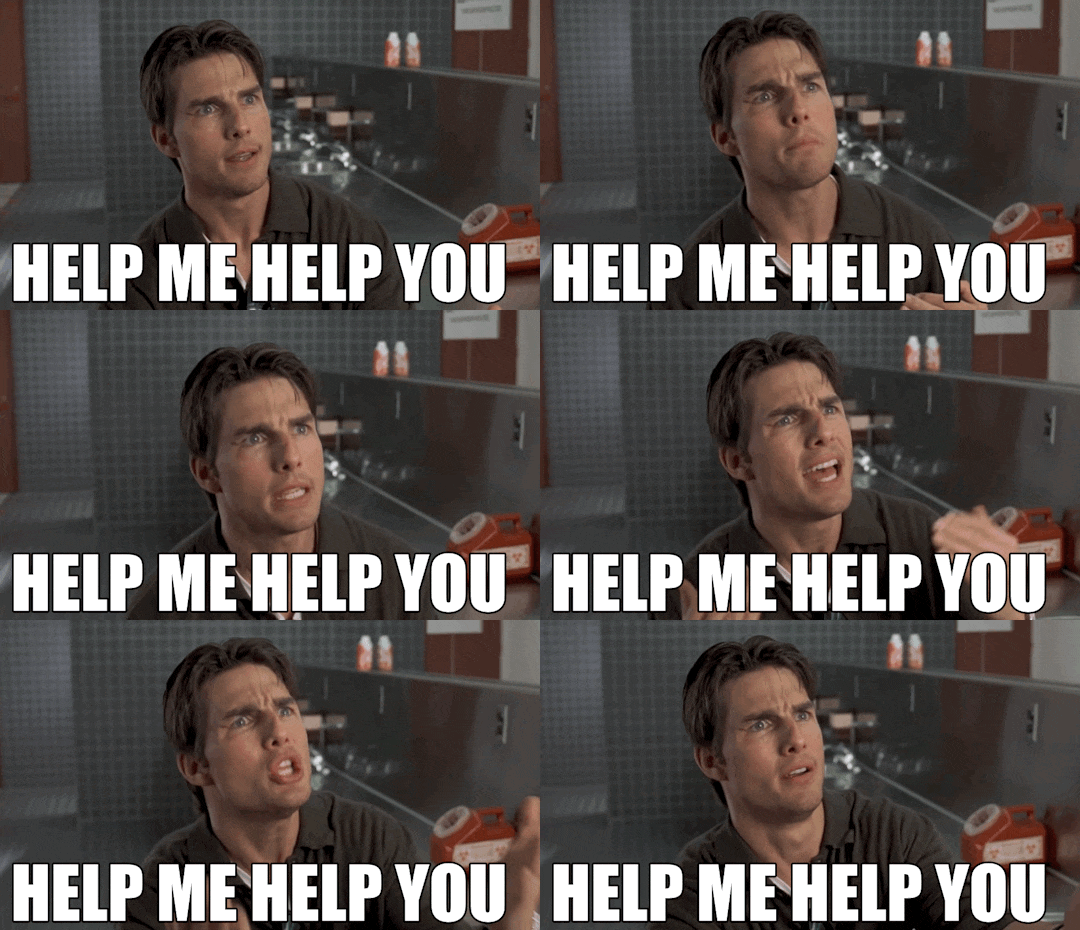
I learned that the quality of the answer often depended on the information I provided. I became better at explaining the problem, sharing the relevant details, asking more specific questions, and correcting the direction when the conversation started moving away from the issue I was actually trying to solve.
In other words, learning how to use AI became a new skill of its own.
Whether you use ChatGPT, Gemini, or another AI assistant, the technology is, at the end of the day, a new tool—and like any new tool, we have to learn how to use it.
Learning to work with AI is not simply a matter of typing a question and accepting the first answer. It requires us to provide useful context, ask better questions, recognize when an answer is incomplete or incorrect, and guide the technology toward a more useful result.
The technology may be powerful, but the person using it still has to bring knowledge, judgment, experience, and critical thinking to the conversation. AI can provide information, generate ideas, and help us work more efficiently—but it cannot always know what we need unless we learn how to communicate that clearly.
And it has not just helped me with the technical work.
Chat has also collaborated with me on the creative side—from brainstorming ideas to helping develop the branding and personality of a new company. It has become a sounding board: a place to explore an idea, work through a problem, or have a conversation that helps me see a project from another perspective.
But it is not just Chat.
Generative AI has also become integrated into many of the creative tools I already use, including Adobe Photoshop and Firefly. Features such as virtual staging and the ability to transform property photographs from daytime scenes into dramatic sunset images have opened up new possibilities for creating compelling marketing visuals while making these types of edits faster, more accessible, and more cost-effective. These tools help streamline parts of the creative process, inspire new ideas, and make certain revisions more efficient. They do not replace the creative decisions behind the work; instead, they help bridge the gap between an initial concept and the finished result, allowing me to bring ideas to life more quickly and effectively.
Although I most often work in Premiere Pro for video editing, there are times—especially when creating social media content—when Canva allows me to bring an idea to life much faster. Canva has incorporated AI throughout many parts of its creative process, making it another valuable tool in my creative workflow.
The important thing is that none of these tools has replaced the creative work.
I am still deciding what the final product should look like. I am still choosing the images, shaping the story, making creative decisions, and determining whether something actually works.
AI may help me move faster, but I am still the one deciding where we are going.
Perhaps that is what adapting to a new technological revolution really means. We do not have to abandon the skills we have spent years developing. We learn how to bring those skills into a new environment—and use new tools to expand what we are capable of creating.
So, is AI a flop?
I don’t think so.
The idea that AI would instantly replace everyone may have been overhyped. The technology is not perfect, and it is not a substitute for human knowledge, judgment, experience, or creativity.
But as the dust settles, AI is proving to be something else: a collaborator, an assistant, and a powerful new tool.
And for creatives willing to learn how to work with it, it may not make us less creative at all.
It may help us become even more creative.